
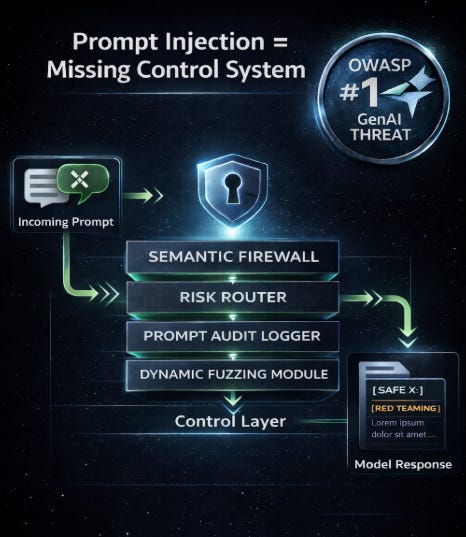
Introduction: The Mirage of Static Defenses
Most enterprises still treat prompt injection like a solvable input sanitization problem. But the reality is deeper: LLMs aren’t traditional software. They’re non-deterministic systems without execution boundaries - and prompt injection exploits that fundamental openness.
The rise of jailbreaks, agent hijacks and data leakage is not a surprise. It’s a signal: enterprises need security models purpose-built for language-based systems.
The Failure of “One-Shot Defenses”
Here’s what hasn’t worked:
Regex Sanitizers: Break easily, brittle and unaware of semantic attacks
Prompt Guards: Static wrappers without state or memory of past interactions
Blacklists: Can’t keep up with new injection patterns or indirect attacks
Enterprises that rely on these alone often experience:
Sudden failures in high-sensitivity workflows
Undetected data exfiltration through natural language queries
Reputational damage when models are tricked into unsafe responses
Prompt Injection as a Systemic Risk
Prompt injection is not just an application-layer concern. It exposes missing primitives across:
Session Memory Models - What context is retained or leaked
Execution Boundaries - What the LLM is allowed to do
Audit Trails - What the model was told and by whom
Model Routing - Whether low-risk requests can be safely sandboxed
It’s not a bug. It’s the absence of a control system.
What a Real Defense Looks Like
The emerging stack to mitigate injection includes:
Intent-aware Firewalls: Parse and score semantic intent before model execution
Quarantine Routes: Route high-risk prompts to hardened, scoped-down models
Token Attribution: Tag all outputs with source + propagation trace
Dynamic Prompt Fuzzing: Real-time adversarial testing per session
Replayable Prompt Audit Trails: Full reconstruction of prompt → model → response
Think of it less like input validation and more like an LLM-aware runtime.
OWASP and the New Security Normal
Prompt injection is now OWASP GenAI Threat #1. But enterprise responses remain lagging.
Why?
Security teams lack visibility into LLM usage
AppSec tools don’t map to GenAI risk surfaces
“Safe prompting” is too reliant on prompt engineers - not systems
It’s time for AI systems to inherit the maturity of API gateways, firewalls and zero-trust patterns.
Metrics to Track
Injection Escape Rate (IER): How often attackers successfully trick your LLM into doing something it shouldn’t.
Risk-Weighted Prompt Score (RPS): A single score that tells you how dangerous a prompt really is based on intent, context and past attack patterns.
Detection Latency (DL): Time taken to identify and flag a high-risk or escaping prompt from initial ingestion.
Audit Replay Coverage (%): Proportion of LLM interactions that can be fully reconstructed end-to-end for forensic analysis and compliance.
Without this telemetry, compliance is aspirational.
The Case for a GenAI Security Control Plane
What Kubernetes did for containers, GenAI security control planes must do for language systems:
Declare intent boundaries
Route per risk policy
Observe across sessions and agents
Enforce escape detection and response
You don’t “fix” prompt injection. You build a system that makes it survivable.
Conclusion: Secure-by-Default, Not Just Prompt-Hardening
Language is not static. Neither are its risks. Prompt injection is here to stay - but it doesn’t have to be fatal.
Enterprises can move from patching to prevention by treating security as a control layer, not a checklist.
We’re FortifyRoot - the LLM Cost, Safety & Audit Control Layer for Production GenAI.
If you’re facing unpredictable LLM spend, safety risks or need auditability across GenAI workloads - we’d be glad to help.