
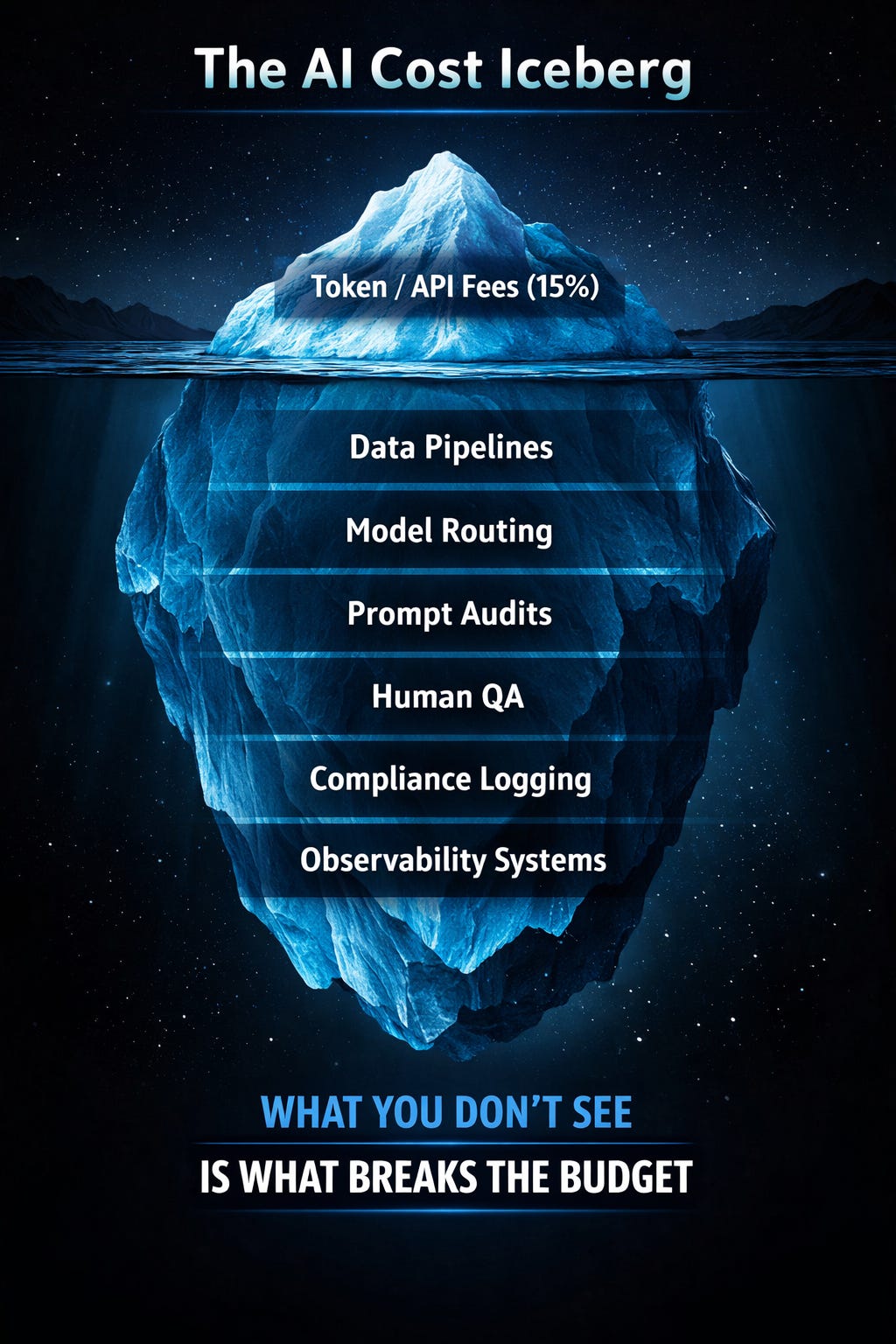
Introduction: The Budget Surprise
Nearly every enterprise deploying generative AI has experienced it: a pilot that runs smoothly and then a production rollout that blows through budgets. IDC(International Data Corporation) reports that 96% of organizations found their GenAI deployments cost more than expected. The cause? A persistent underestimation of the hidden cost layers beneath token usage.
The Real Cost Profile
Visible LLM inference costs typically account for only 15-20% of the total AI stack. The remaining 80-85% is buried across:
Data Engineering Pipelines: Retrieval, cleaning and formatting
Inference Infrastructure: Serving latency, redundancy, failover
Monitoring & Drift Management: Accuracy checks, continual evaluation
Compliance & Governance: PII scanning, prompt logging, legal review
Human-in-the-Loop Oversight: QA, red-teaming, approvals
These elements are not optional - they are foundational to a safe and reliable GenAI deployment.
Common Pitfalls That Break Budgets
Context Bloat: Overstuffed prompts with large context windows trigger higher token counts per request.
Unbounded Agents: Poorly bounded LLM agents or recursive calls cause usage spikes (a top OWASP GenAI risk).
Lack of Routing Logic: Sending all traffic to GPT-4 instead of routing to lower-cost, sufficient models for simpler tasks.
Delayed Observability: Without early-stage cost tracking, runaway jobs go undetected until invoices arrive.
Framework for AI Cost Governance
A robust governance system should include:
Per-Workflow Budgeting: Define spend ceilings by team, user or use-case
Fallback Models: Route low-complexity requests to smaller, cheaper models
Token-Level Cost Alerts: Set real-time alerts when spend anomalies occur
Semantic Caching: Avoid redundant calls with cache-first logic for repeat queries
Replayable Audit Logs: Cost and usage data should be attributable to specific prompts and responses
Enterprises adopting this model report up to 40-60% cost reductions without sacrificing performance.
Building the Control Plane
The goal isn’t just lower costs - it’s predictable and governable costs. A GenAI control plane should unify:
Inference routing
Policy enforcement
Budget thresholds
Logging and attribution
This mirrors what FinOps did for cloud infrastructure: visibility + automation + accountability.
Metrics That Matter
Token Cost per Workflow
Monthly Cost Volatility (CV%)
Percent Routed to Fallback Models
Cache Hit Rate
Cost per Quality Point (CpQ)
Conclusion: From Pilot Chaos to Scalable Confidence
Budget surprises kill trust. By surfacing and governing the invisible layers of AI cost, teams can scale with confidence, not fear. Generative AI is powerful - but only when controlled like any other enterprise-grade system.
We’re FortifyRoot - the LLM Cost, Safety & Audit Control Layer for Production GenAI.
If you’re facing unpredictable LLM spend, safety risks or need auditability across GenAI workloads - we’d be glad to help.