
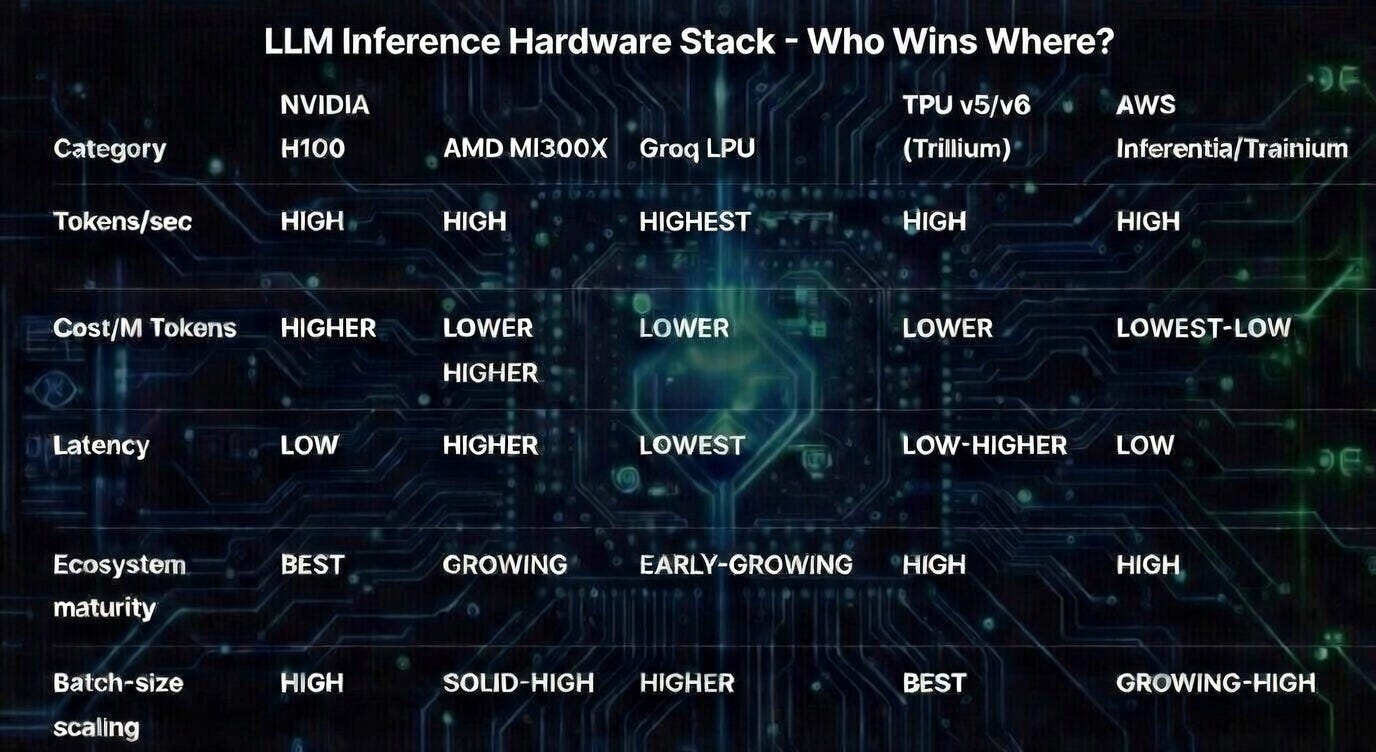
Introduction: Beyond Just GPUs
As GenAI matures, inference costs - not training - dominate enterprise LLM spend. Choosing the wrong hardware stack leads to silent inefficiencies. A 5x latency gap or 70% cost delta per token is entirely possible based on chip selection alone. For many, the default (NVIDIA) is powerful but not always optimal.
Core Players in Inference Compute
NVIDIA H100/H200: Ubiquitous, CUDA-optimized, supported across cloud platforms. Strong training and inference.
AMD MI300X: 192 GB HBM(High Bandwidth Memory), great memory bandwidth. Microsoft is betting on these for Azure OpenAI workloads.
Google TPUs (v4–v6e): Tight TensorFlow integration. Anthropic’s Claude stack is TPU-optimized. Now they support both PyTorch(via XLA) and JAX.
AWS Inferentia2: Cheaper per-token inference for high-volume tasks. Limited ecosystem.
Groq LPU: 800+ tokens/sec deterministic inference at <$1/M tokens. Extremely fast, but limited to inference only.
Cerebras WSE-3: One-chip large model execution. Ideal for research, extreme batch size.
How the Wrong Choice Hurts
Latency Spikes: High tail latencies mean slower responses to users and support costs go up.
Over-provisioned Memory: Paying for massive HBM you don’t need for small models.
Vendor Lock: Ecosystem rigidity can prevent switching or cost-based rebalancing.
Wasted Throughput: Training-optimized chips used inefficiently for real-time inference.
Metric-Based Hardware Selection
Instead of defaulting to the popular chip, measure:
Tokens/sec @ p95 latency
Effective cost per million tokens
Power usage per inference batch
Throughput at different batch sizes
Benchmark these metrics using your model (e.g., LLaMA 70B, Claude, GPT) against workload type (chat vs classification).
Hybrid Model = Hybrid Hardware
Run high-volume, low-sensitivity tasks on Groq or Inferentia
Use NVIDIA or AMD GPUs for general-purpose, high-customization workloads
Deploy large batch, research-grade LLMs on Cerebras or TPUv5e
Cloud Marketplace Matters
Hardware is only as useful as its availability:
CoreWeave, Lambda: Cheaper GPU rentals
GCP: TPUs for high-performance training/inference using TensorFlow or JAX
AWS: Deep ecosystem but costlier GPU hours
Dedicated colocation: for high-utilization teams
Enterprise Decision Framework
When choosing a stack:
What is your latency requirement?
How variable is your prompt size?
Are models fixed or swappable?
What is your vendor lock tolerance?
Can you split traffic by workload class?
Conclusion: Inference Strategy is a FinOps Lever
Enterprises often assume hardware is a sunk cost. It’s not. For GenAI, inference hardware is a strategic choice - one that materially affects latency, cost-per-output and resilience. Treat hardware choice like a service contract: benchmark, model and revisit regularly.
We’re FortifyRoot - the LLM Cost, Safety & Audit Control Layer for Production GenAI.
If you’re facing unpredictable LLM spend, safety risks or need auditability across GenAI workloads - we’d be glad to help.