
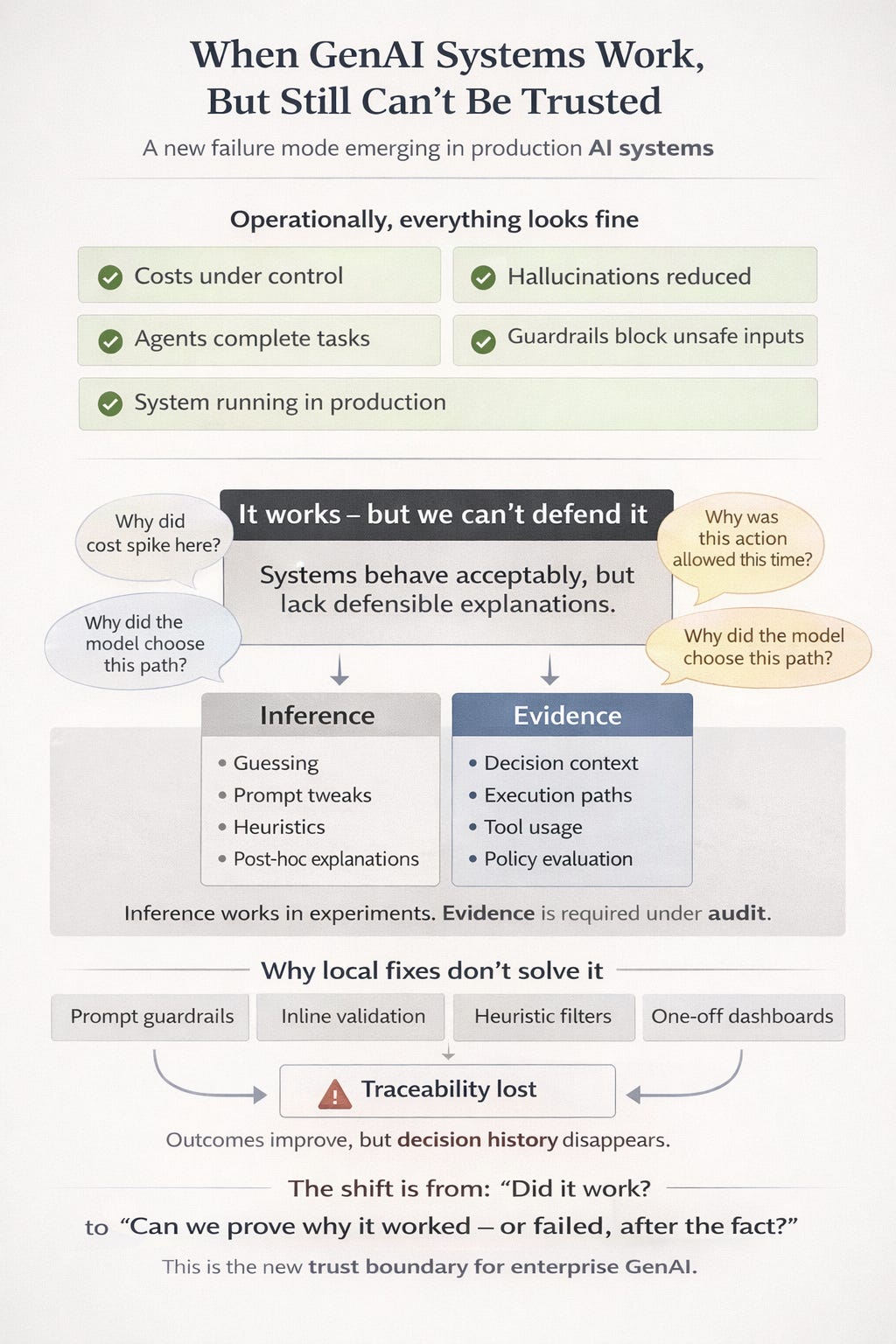
Across recent developer, security and AI agent discussions, a subtle but consistent theme keeps surfacing.
Teams are not reporting widespread system failures.
In many cases, systems are working.
Costs are lower.
Hallucinations appear reduced.
Agents complete tasks.
Guardrails block unsafe inputs.
And yet, discomfort remains.
Not because outcomes are wrong - but because teams cannot convincingly explain why outcomes occurred.
This gap rarely shows up in demos. It appears later, during review, scrutiny, or escalation.
The New Failure Mode: “It Works, But We Can’t Defend It”
A growing number of discussions point to the same underlying problem:
Systems behave acceptably in production, but lack defensible explanations when questioned.
Examples appear across domains:
Cost optimization threads where teams reduce spend dramatically, but cannot attribute which workflows or which behavioral changes caused the savings - or whether they will persist.
Security threads where exploit paths are identified, but systems cannot prove whether they were actually exercised.
Reliability discussions where hallucinations appear reduced, but it’s unclear whether reasoning improved or autonomy was simply constrained.
Agent monitoring conversations where API calls are logged, yet decision context is missing - leaving incident reviews speculative.
In each case, the system does not fail operationally.
It fails epistemically.
Why This Is a New Class of Risk
Traditional software failures are observable:
An API goes down
A request errors
A service breaches an SLA
GenAI failures are different.
They often surface as questions rather than incidents:
Why did this cost spike here?
Why was this action allowed this time?
Why did the model choose this path over another?
Why did behavior change after a prompt tweak?
When systems cannot answer these questions with evidence, teams rely on inference rather than reconstruction.
That distinction matters.
Inference is acceptable during experimentation.
It is not acceptable under audit, regulatory review, or executive scrutiny.
The Illusion of Control Through Local Fixes
Many teams respond to this uncertainty with local solutions:
Prompt-level guardrails
Inline validation logic
Heuristic filters
One-off dashboards
These measures often improve outcomes - which reinforces confidence.
But they do not preserve decision context.
As a result:
Improvements cannot be defended later
Trade-offs are not visible
Risk accumulates silently
The system appears stable, but its behavior cannot be narrated.
Why Mature Teams Notice This First
This pattern tends to surface earlier in teams that are:
Handling sensitive or regulated data
Operating multi-agent or tool-using workflows
Accountable to security, compliance, or finance stakeholders
Running post-incident or post-cost-review processes
In these environments, “the model behaved that way” is not an answer - it’s an escalation trigger.
What matters is not just what the system did, but:
Which context influenced the decision
Which alternatives were available
Which constraints were evaluated
Which policies allowed or blocked the action
Without that, trust becomes fragile.
A Question Buyers Are Quietly Asking
Across these discussions, an implicit question keeps appearing - rarely stated directly:
If we had to explain this system’s behavior six months from now, could we?
Not to ourselves.
Not to the engineering team that built it.
But to:
Security reviewers
Compliance teams
Finance leadership
External auditors
Customers
Many teams realize the answer only after something draws attention.
The Shift That Follows
Teams that recognize this gap early begin to change how they think about GenAI systems.
The focus moves from:
“Did it work?”
to:“Can we explain why it worked - or failed - after the fact?”
This shift affects architecture, ownership and accountability.
It also separates systems that appear reliable from systems that can be trusted under scrutiny.
Closing Observation
The most important GenAI conversations today are not about models, benchmarks, or features.
They are about defensibility:
Can behavior be reconstructed?
Can decisions be explained?
Can outcomes be justified after pressure is applied?
Those questions are emerging quietly, in technical threads and post-incident reflections.
They are worth paying attention to - especially before someone else starts asking them.
We’re FortifyRoot - the LLM Cost, Safety & Audit Control Layer for Production GenAI.
If you’re facing unpredictable LLM spend, safety risks or need auditability across GenAI workloads - we’d be glad to help.