
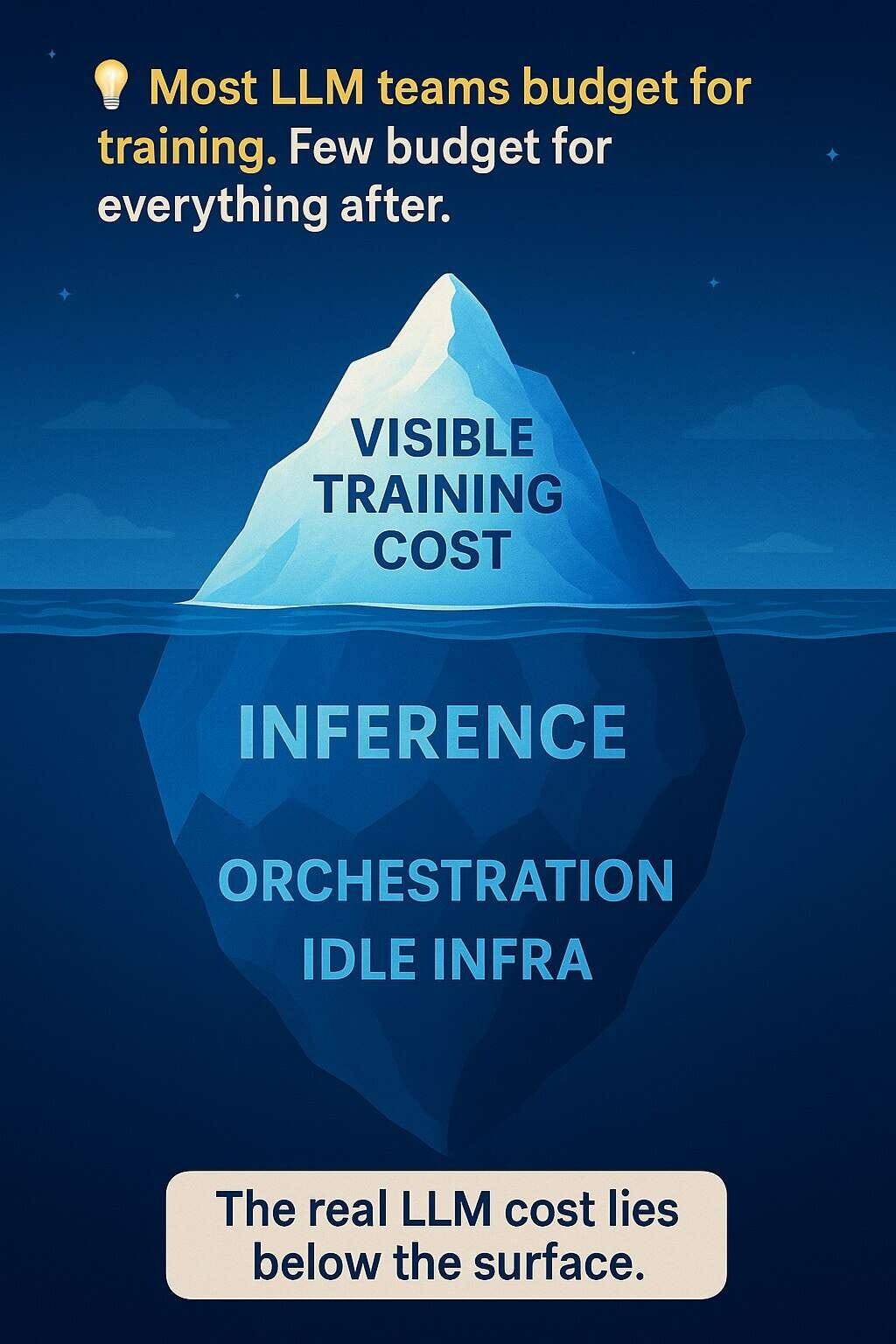
The Quiet Problem No One Budgets For
Between 2023 and 2025, enterprise teams everywhere rushed to embed large language models (LLMs) into production - chat assistants, RAG systems, summarisation bots. The excitement was justified. What most engineering leads discovered later was the unspoken cost curve.
Training GPT-4 reportedly exceeded $100 million and even Google’s Gemini family crossed $191 million in compute and energy (Cudo Compute). Yet those headline numbers hide a deeper story: for most Small and Medium-sized Enterprises(SMEs), it’s not the training that hurts - it’s inference and orchestration.
Even with inference prices dropping, Andreessen Horowitz notes a paradox: enterprise LLM bills are rising, not shrinking, because of inefficient prompts, static RAG pipelines and poor utilisation(a16z.com).
Anatomy of an Invisible Bill
What drives those runaway costs?
Token economics: Commercial APIs price by input + output tokens - every extra word in a prompt or long answer burns budget. Token calculators show cost spread from <$1 to $15 per million tokens depending on model and window size (OpenAI Pricing).
Model size obsession: Teams often default to “largest = best.” But empirical work like FrugalGPT proves cascading smaller models can cut spend by 98% with negligible accuracy loss.
Retrieval overhead: RAG pipelines feed documents wholesale into context windows. Every extra KB becomes tokens and costs.
Idle infrastructure: Self-hosting looks cheaper until utilisation drops. Dell’s 2025 analysis found 70 B-parameter inference on-prem could be 4.1x cheaper than API - but only at high steady load (Dell Technologies White Paper).
Scaling friction: Under-instrumented systems bleed GPU hours through low batching, poor routing and cold starts.
Why It Matters Now
For SMEs, this isn’t academic. The danger is a pilot that works technically but collapses financially once user traffic grows. A16Z’s 2024 LLM Cost Report quantified a 10x annual improvement in raw inference efficiency - yet most companies saw flat or rising total bills.
Meanwhile, NVIDIA’s benchmarking warns:
“Inference remains a significant challenge due to latency, cost and compute demands.” (NVIDIA Developer Blog)
In short: cheaper tokens ≠ cheaper systems. Without governance, cost per query drifts upward until scaling halts.
Industry Signals
Price compression wars. Chinese vendors cut API prices 50-88% in 2024 (Reuters).
Inference whales. Start-ups face customers whose token use skews heavily against averages (‘Inference whales’ are eating into AI coding startups’ business model).
Research focus shift. Alibaba’s End-to-End Optimization for Cost-Efficient LLMs pushes distillation and quantisation mainstream.
Lessons for Builders
Instrument from day one. Track tokens, cost per query and model tier.
Model-tier routing. Reserve top models only for complex or business-critical queries.
Prompt discipline. Trim verbosity; cache recurring system prompts and responses.
Monitor utilisation. Idle GPUs are silent cost multipliers.
Set KPIs. Define acceptable cost / latency / accuracy bands and revisit quarterly.
What the Next Phase Explores
Part 2 of this series will move from cost anatomy to engineering strategies - model tiering, prompt compaction, dynamic RAG routing and hybrid deployments. Expect real-world data and implementation guidance drawn from current FinOps and LLM Ops research.
We’re FortifyRoot - the LLM Cost, Safety & Audit Control Layer for Production GenAI.
If you’re facing unpredictable LLM spend, safety risks or need auditability across GenAI workloads - we’d be glad to help.