
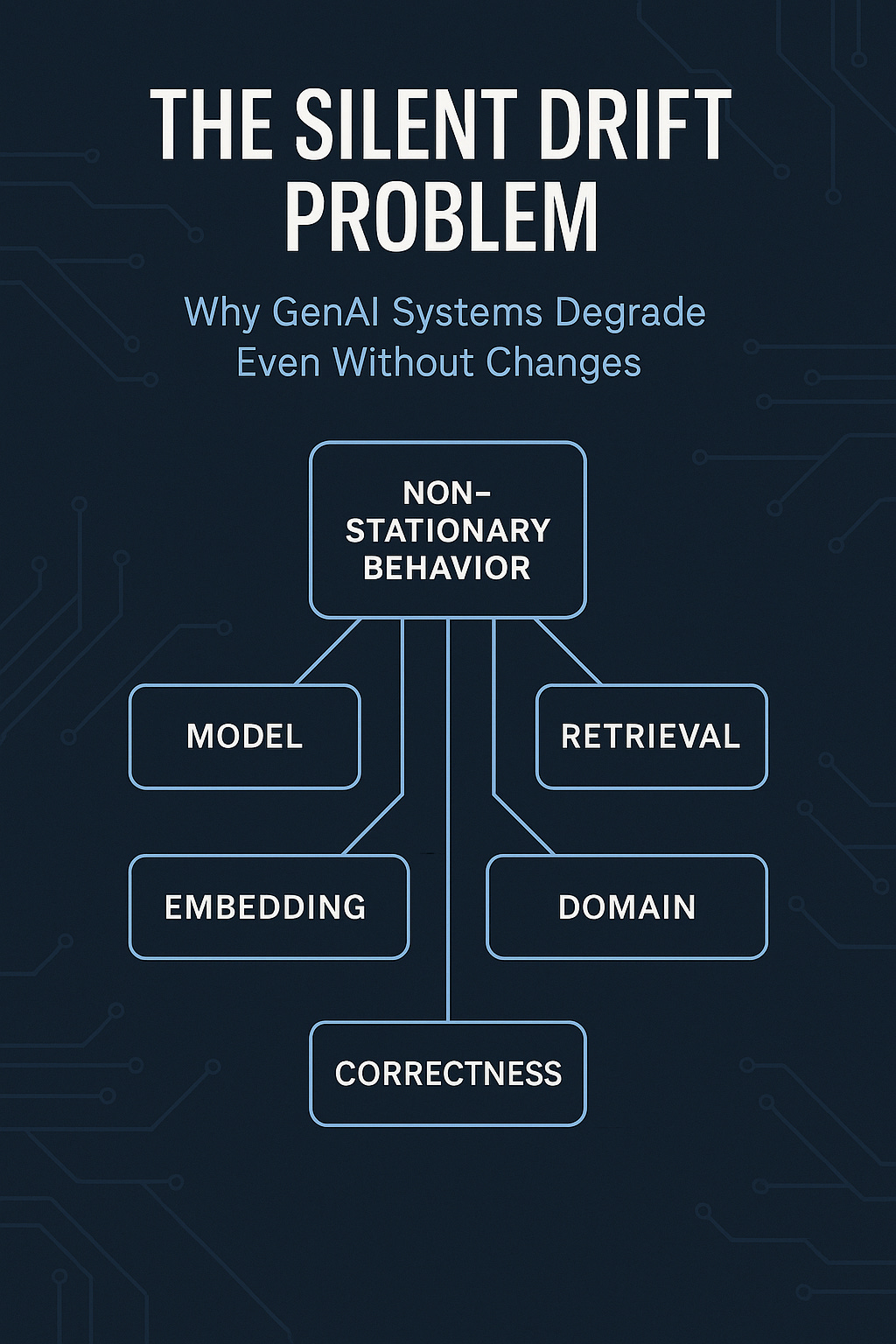
GenAI systems don’t fail the way traditional software does.
They don’t throw 500s.
They don’t crash.
They don’t show memory leaks or CPU saturation.
Instead, they fail silently.
A model that produced crisp, grounded, helpful answers in January slowly becomes less accurate, less relevant, more generic or more cautious by March.
Teams notice subtle signals:
“This feels different from last month.”
“Why is retrieval pulling irrelevant chunks now?”
“Accuracy seems lower but nothing has changed.”
“Why is the model refusing safe instructions suddenly?”
This is the reality of LLM Drift - the most widespread, underdiagnosed failure mode in production GenAI systems today.
And the paradox is simple:
Nothing changed in your code.
But the system changed anyway.
This part explains the five root causes of drift, the symptoms that appear before decay becomes severe and why drift is not a bug - but a fundamental property of GenAI systems.
Later in this series:
Part 2 will detail how to engineer drift detection that catches issues before users complain.
Part 3 will introduce QRI (Quality Reliability Index) - the governance layer that turns quality into a trackable KPI.
The Drift Paradox: Why LLM Systems Change Even When You Don’t
In classical software, versioning, deployments and infra updates are fully controlled. If behavior changes, there’s a direct cause. LLMs break this mental model.
LLM pipelines change due to factors you do not control:
Provider-side model updates
Embedding model updates
Safety filter changes
Retrieval data evolution
Domain shifts
User-query distribution changes
Prompt variance buildup
RAG index aging
Context inflation
This creates the paradoxical experience:
“We touched nothing, but the output is different.”
Before diving into the mechanics, here’s the observation that matters:
LLMs are non-stationary systems.
Their behavior drifts over time, even with zero code changes. And for enterprises without evaluation pipelines, this drift accumulates unnoticed until it becomes a major outage.
The Five Primary Forms of LLM Drift
Drift is not one problem - it is a cluster of interconnected phenomena.
Below are the five types seen most consistently across SMEs.
1. Model Drift (Provider-Side Updates)
Model providers frequently:
Inference optimization
Adjust routing tiers
Modify sampling defaults
Patch safety layers
Alter attention constraints
Update prompt templates
Introduce new alignment rules
This causes shifts in:
Tone
Answer structure
Grounding behavior
Hallucination frequency
Refusal patterns
Output length
Latency
This is the most common drift type - and the hardest for enterprises to detect. Recent work has shown that even “versioned” LLMs can experience behavioral drift due to silent provider-side updates in routing, alignment layers and decoding defaults, leading to measurable semantic shifts over weeks (see Zheng et al., 2025).
2. Embedding Drift (Vector Space Shifts)
Embedding models change even more frequently than LLMs.
Updates to:
Tokenization
Vector normalization
Dimensionality
Underlying training data
Semantic clustering
….cause your entire vector index to drift relative to new embeddings. Studies(like Liu et al., 2025) have found that these drift break retrieval consistency.
RAG pipelines suffer heavily from this: Old vectors ≠ new vectors. Even slight changes break retrieval alignment.
3. Retrieval Drift (Aging Knowledge Corpus)
Retrieval quality degrades due to:
Outdated documents
Metadata misalignment
Chunk-level topic drift
Incorrect prioritization
Index bloat
Domain-document distribution shift
When retrieval decays, the LLM’s quality decays even if the LLM itself is stable.
Retrieval Drift is the #1 cause of “mysterious hallucinations” in enterprises.
4. Domain Drift (The World Evolves, The Model Doesn’t)
LLMs freeze at training time.
Meanwhile, your world changes:
Product features
Pricing
Compliance rules
Organizational structure
Customer terminology
Regulatory environment
Market vocabulary
This creates a widening gap between what the model believes and what your business now requires.
5. Safety & Alignment Drift
Safety-guideline changes can cause:
Sudden refusals
Over-cautious tone
Unnecessary disclaimers
Hallucinated safety messages
Blocked harmless queries
This happens because alignment layers evolve in the provider stack.
Why Drift Matters More in Some Sectors
Drift affects every GenAI deployment - but it is mission-critical in certain industries due to regulatory exposure, financial risk, or user trust.
A short, non-exhaustive overview:
Fintech & Lending
Drift in summarization or decision-support leads to:
Inconsistent recommendation tone
Hallucinated financial advice
Missing disclaimers
Mismatched thresholds
Accuracy and stability are legally sensitive.
Healthcare & MedTech
Drift influences symptoms classification, medical summarization and clinical Q&A. Even a small % drop in grounding can have clinical risk.
HRTech & Recruiting
Drift affects summarization, candidate scoring and policy alignment. Bias can unintentionally increase or decrease over time.
Customer Support Platforms
Drift leads to:
Incorrect troubleshooting steps
Missing context
Outdated product knowledge
Wrong escalation paths
This hurts CSAT(Customer Satisfaction Score) and churn.
LegalTech & Compliance Automation
Grounding drift or safety drift creates:
Misinterpreted policies
Hallucinated legal interpretations
Compliance violations
High-stakes domain.
SaaS Platforms Integrating GenAI
Drift directly impacts product reliability, onboarding and automation quality.
GenAI drift is universal - but for these sectors, it’s existentially critical. This trilogy gives you tools to manage it.
Early Warning Signals of Drift
Like structural cracks in a bridge, drift presents subtle symptoms before failure.
Teams should watch for:
Grounding Score Drop: Output becomes less aligned to retrieved evidence.
Retrieval Overlap Decline: Same query → different chunks.
Embedding Distance Shift: New embeddings diverge significantly from historical vectors.
Increase in Refusals: Safety drift causing unintentional over-blocking.
Output Tone Variability: AI stops sounding like the same assistant.
“Overconfident Wrong Answers”: A spike in confident hallucinations is a major drift signal.
User Complaints: When users notice drift, it’s already severe.
Why Drift Is Inevitable
Drift is not a preventable bug. It is a fundamental property of:
Non-deterministic models
Provider-side updates
Shifting context windows
Evolving knowledge corpora
Changing safety layers
Domain volatility
This phenomenon aligns with recent findings on the “half-life of truth” in LLMs, where factual grounding decays over time due to semantic drift, retrieval misalignment and recursive generation instability (see Sharma et al., 2025).
Which means:
At present, you cannot prevent drift. You can only detect and govern it.
What’s Next in This Series
In Part 2, we’ll move from problem exposure to engineering practice:
Grounding monitors
Retrieval consistency checks
Embedding stability testing
Golden-set evaluation
Canary queries
Drift thresholds
Drift Engine reference architecture
We’re FortifyRoot - the LLM Cost, Safety & Audit Control Layer for Production GenAI.
If you’re facing unpredictable LLM spend, safety risks or need auditability across GenAI workloads - we’d be glad to help.